Abstract Submission Deadline Extended to 4 May 2026 • International Conference & Doctoral Colloquium 2026 • SMS Research Forum, School of Management Studies, CUSAT • "Ignite the Research Aptitude" • Abstract Submission Deadline Extended to 4 May 2026 • International Conference & Doctoral Colloquium 2026 • SMS Research Forum, School of Management Studies, CUSAT • "Ignite the Research Aptitude" • Abstract Submission Deadline Extended to 4 May 2026 • International Conference & Doctoral Colloquium 2026 • SMS Research Forum, School of Management Studies, CUSAT • "Ignite the Research Aptitude" •

Conference Section

International Conference and Doctoral Colloquium 2026

This conference section is designed to help participants, authors, and doctoral scholars quickly find theme details, track information, participation guidance, and colloquium expectations.

Conference Papers

Conference Papers and Submission Guidelines

The conference invites the academic community and industry professionals to contribute papers, white papers, and doctoral research discussions aligned with the theme of Digital Futures: Reimagining Social and Business Models.

Deadline Extended

Abstract Submission

4 May 2026

Full Paper Submission

10 May 2026

Full paper submission is mandatory only for consideration for journal publication.

Registration Alert

Early bird registration closes on 15 April 2026.

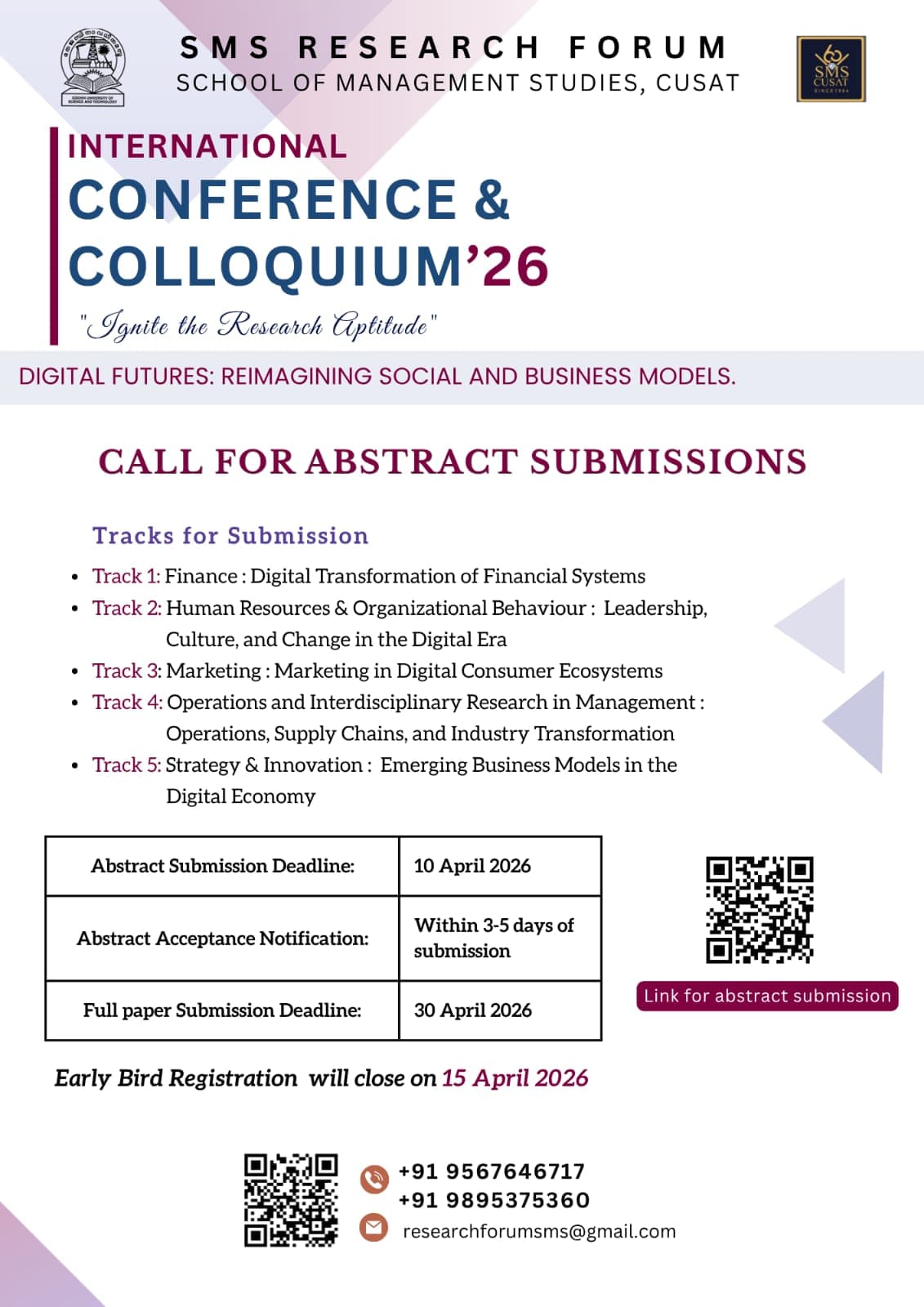
Call for abstract submissions flyer for Conference and Colloquium 2026

Track 1

Finance

Digital Transformation of Financial Systems

Digital technologies are reshaping financial markets, inclusion, and regulation. This track welcomes work on how finance responds to technological disruption while promoting responsible innovation, transparency, and sustainable growth.

FinTech innovations and digital financial ecosystems
Blockchain, cryptocurrencies, and decentralized finance
Artificial intelligence, big data, and analytics in financial decision-making
Digital payments, mobile banking, and cashless economies
Financial inclusion through digital technologies
Cybersecurity, fraud detection, and risk management in digital finance
RegTech and governance of digital financial systems
Sustainable and green finance in the digital economy
Digital transformation of banking and financial institutions
Emerging business models in financial services

Track 2

Human Resources & Organizational Behaviour

Leadership, Culture, and Change in the Digital Era

As organizations undergo rapid digital transformation, both human resource practices and organizational behavior are being fundamentally reshaped. This track explores how leadership, culture, and workforce dynamics evolve in technology-driven environments, with a focus on AI integration, employee well-being, digital collaboration, and responsible change management. It invites research on building agile, inclusive, and future-ready organizations that effectively align people, technology, and strategy.

Artificial Intelligence, Automation, and Human-AI Collaboration in Organizations
Digital Leadership and Leadership in Technology-Driven Work Environments
People Analytics, Data-Driven Decision-Making, and Workforce Insights
Workforce transformation, reskilling, and continuous learning
Hybrid work, remote work, and digital collaboration practices
Organizational culture, climate, and employee engagement in virtual environments
Employee well-being, motivation, and work-life balance in digital workplaces
Ethical HR practices, algorithmic fairness, and responsible leadership
Change management, organizational adaptation, and technology adoption behaviour
Diversity, equity, inclusion, and organizational resilience in the Digital Era

Track 3

Marketing

Marketing in Digital Consumer Ecosystems

This track explores how digital platforms, data, and evolving consumer behavior are transforming contemporary marketing strategy.

Artificial intelligence and automation in marketing strategy
Social commerce, influencer ecosystems, and creator economies
Customer analytics, big data, and predictive marketing
Consumer behaviour in digital and emerging market contexts
Omnichannel marketing and digital customer experience
Platform-based marketing and digital marketplace strategies
Personalization, recommendation systems, and data-driven engagement
Ethical and responsible marketing in algorithmic environments
Digital branding, community building, and online engagement
Marketing innovation in the digital economy

Track 4

Operations, Knowledge Systems, and Interdisciplinary Research in Management

Knowledge Processes, Operations Strategy, and Digital Transformation

This track examines knowledge processes, operational systems, and interdisciplinary management research. It welcomes work on how organisations manage, integrate, and leverage knowledge alongside digital and operational capabilities to drive innovation and sustainable performance.

Knowledge processes, flows, and organisational workflows
Knowledge management systems and digital platforms
Data–information–knowledge transformation and analytics
Organisational learning and knowledge sharing cultures
Knowledge ecosystems and inter-organisational networks
Operations strategy and knowledge integration
Supply chain knowledge and information flows
Digital transformation and intelligent operations
Knowledge-driven innovation and process improvement
Interdisciplinary approaches to knowledge and operations

Track 5

Strategy & Innovation

Emerging Business Models in the Digital Economy

This track looks at how firms rethink innovation, competition, and value creation in response to technological change and digital disruption.

Artificial intelligence and technology-driven innovation
Platform-based business models and digital ecosystems
Digital entrepreneurship and startup innovation
Strategic management in technology-driven industries
Emerging business models in the digital economy
Sustainable strategy and responsible innovation
Business model innovation in emerging and developing markets
Innovation ecosystems, open innovation, and collaborative networks
Strategic agility, dynamic capabilities, and organizational adaptation
Industry disruption and competitive strategy in the digital era

Submission Guidelines

International Conference Submission Guidelines

Abstract Submission

  • The abstract should not exceed 250 words.
  • The abstract must clearly include the purpose of the study, method or design, major findings, and the originality or contribution of the study.
  • Authors should ensure the abstract concisely reflects the core contribution of the research.

Full Paper Submission

  • The full paper length should be between 2500 and 3000 words.
  • Authors must follow APA guidelines.
  • The manuscript must maintain academic integrity with plagiarism not exceeding 10%.
  • Submissions should present original and unpublished work.
  • The entire submission, including title, abstract, text, figures, graphs, tables, and references, must be contained in one document.

Publication Opportunities

Journal Consideration for Selected Full Papers

Only full papers submitted to the conference will be considered for publication in these journals.

Journal of Knowledge Management

Scopus Q1, ABDC Ranking - A

Emerald

Journal of Global Marketing

Scopus Q1, ABDC Ranking - B

Taylor & Francis

Journal of Creative Communication

Scopus Q2, ABDC Ranking - C

SAGE

SMS Journal of Business Management

Institutional journal publication opportunity

School of Management Studies